

PDRN serum does not work like a regular hydrating serum. You cannot just squeeze it in wherever there is a gap in your routine and expect glass skin by morning. I learned this the slow way, about three weeks into using the medicube PDRN Pink Peptide Serum, when my skin looked fine but not that glowing, translucent, caught-in-the-light way I kept seeing in Korean skincare content. Nothing was wrong. Nothing was happening, either. The serum was sitting in my routine in the wrong position, sandwiched between products that were blocking it or diluting it before it ever touched my skin barrier.
Once I fixed the layering order, things changed noticeably within a week. The glass-skin effect that PDRN serums are actually capable of delivering is real, but it depends almost entirely on the steps around it. This guide covers exactly what I changed, and why each step in the sequence matters for polynucleotide actives specifically.
Layering it wrong is the reason your PDRN serum is not doing much
The medicube PDRN Pink Peptide Serum has over 16,000 five-star reviews and costs less than a dinner out. But it only performs when applied at the right step, onto the right prep. Check today's price and see what 16,000 people already figured out.
Amazon Check Today's Price on Amazon →Why Layering Order Matters More for PDRN Than for Other Serums
Most serums are forgiving. Vitamin C, niacinamide, even hyaluronic acid can absorb reasonably well in slightly different positions in a routine. PDRN is different because of what it is and what it needs to do. Polynucleotides, the active class in PDRN (short for polydeoxyribonucleotide), are long-chain nucleic acid fragments. Their job is to signal skin cells to repair themselves, support collagen production, and improve skin texture from within. That is not a job that happens on the surface. They need to penetrate.
To penetrate, they need three things: a slightly moist skin surface, no occlusive barrier blocking the path, and no competing actives creating an acidic environment that denatures them. Apply PDRN serum after a rich moisturizer, for instance, and you have created a barrier it cannot pass through. Apply it over a low-pH acid exfoliant without rinsing properly, and you have changed the skin environment enough that the polynucleotides lose effectiveness before they can work. These are small things that make a large difference.
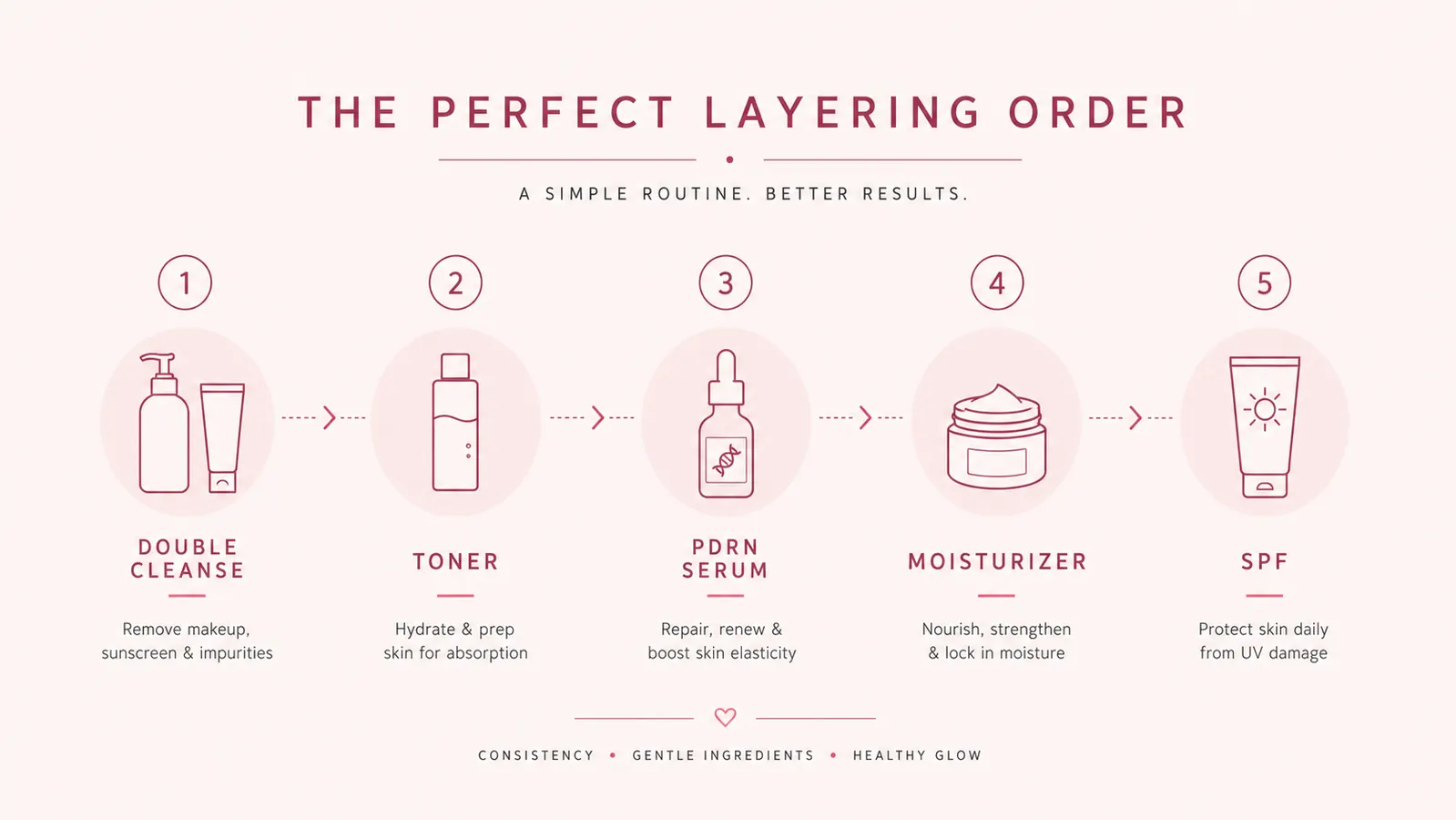
Step 1: Double Cleanse Properly and Do Not Skip the Second Step
This sounds obvious but it trips people up more than any other step. PDRN serum needs to land on clean skin, not on skin with residual sunscreen, silicone, or oil-based residue sitting on top of it. The first cleanse (oil or balm) removes SPF and makeup. The second cleanse (water-based, low or neutral pH) removes the film left behind by the first cleanser plus any sweat or sebum. Do both, even in the morning if you use overnight products.
For morning routines, I use a gentle low-lather gel that rinses completely clean and leaves my skin feeling slightly damp but not tight. For evening, a cleansing balm followed by a foaming gel cleanser. The goal after the second cleanse is skin that feels supple, not squeaky. Tight or dry after cleansing means your cleanser is too stripping, and a stripped skin barrier will not absorb PDRN the way it should.
Pat dry with a clean towel, but leave a little moisture on the skin surface. This is intentional. Slightly damp skin absorbs water-based serums faster and more evenly than bone-dry skin.
Step 2: Apply a Hydrating Toner to Prime the Surface
The step that makes the biggest single difference in PDRN performance is what goes on just before it: a hydrating, pH-balanced toner applied to damp skin. Think of this as priming a wall before painting. A good toner softens the upper layers of the skin, opens up the pathways between cells, and creates a slightly hydrated medium that helps the PDRN serum distribute evenly and travel deeper.
What you want here is something simple, not layered with actives. A basic fermented water toner, a hyaluronic acid first essence, or a plain hydration mist all work well. What you do not want is a toner with AHAs, BHAs, or a pH below 4.5. Acidic toners can interfere with polynucleotide stability. Keep this prep step neutral and hydrating only.
Pat the toner in gently using your palms, not a cotton pad. Cotton removes more product than it delivers. Press it into your cheeks and forehead, wait about 20 seconds, and then go straight to the serum while the surface is still slightly tacky from the toner. That window is when absorption is at its peak.
The glass-skin effect that PDRN actually delivers is real. But it depends almost entirely on what you do before and after the serum, not just the serum itself.
Step 3: Apply the PDRN Serum Using the Press-and-Hold Technique
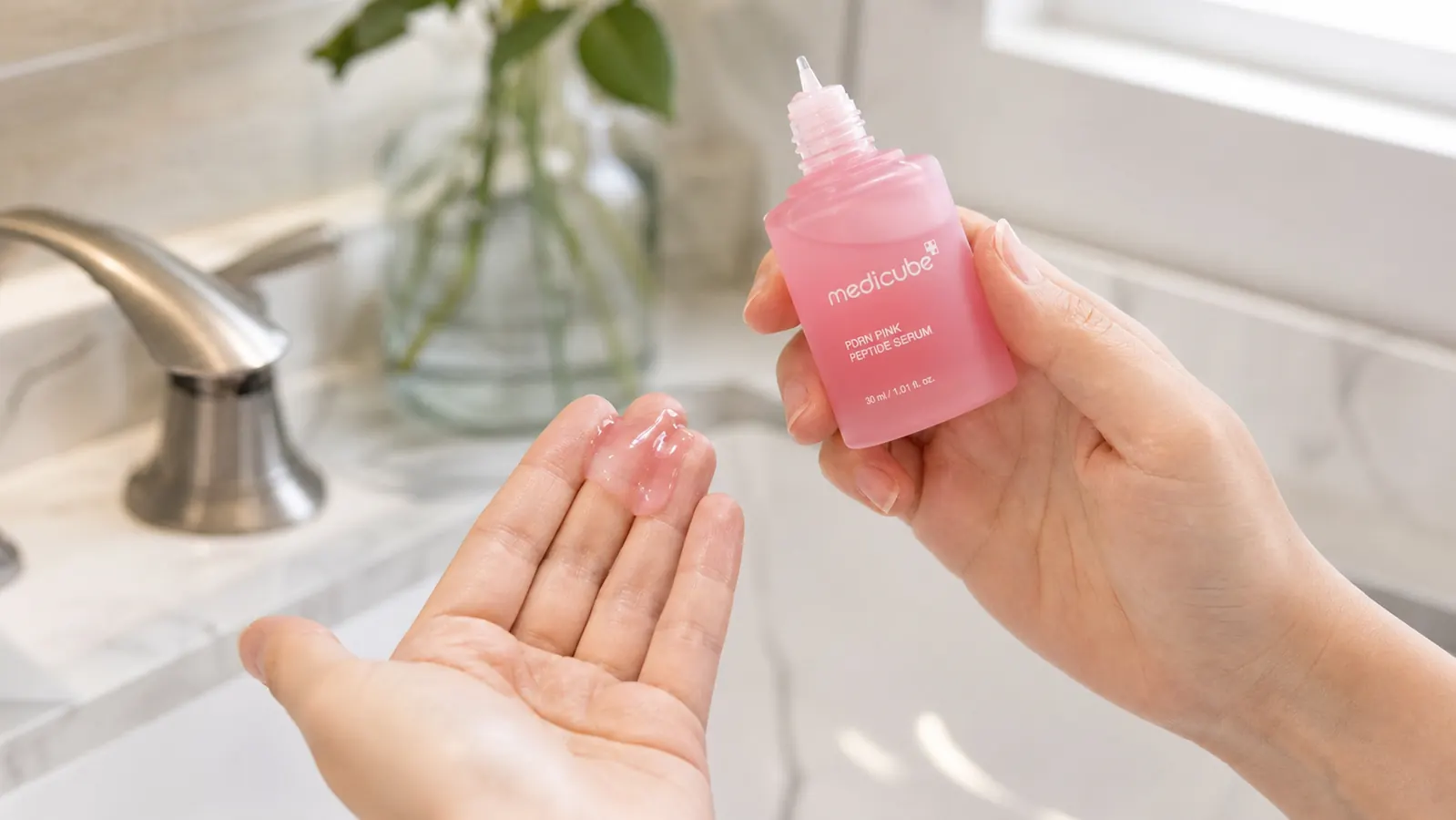
This is the main event. With the medicube PDRN Pink Peptide Serum, I use three to four drops for my whole face. The serum has a lightweight, slightly gel-water texture that spreads easily without dragging. Dispense it into your palm, warm it for a second between both hands, then press your palms flat against your cheeks and hold for about five seconds before lifting.
This press-and-hold technique is different from the patting or rubbing most people default to. Pressing creates gentle pressure that encourages the serum to move through the skin instead of just sitting on top of it. Work from the center of the face outward, and give extra time to any areas with visible texture, lines around the eyes, or persistent dryness. Those zones benefit from slightly slower pressing.
Do not rub. Rubbing with a serum this active causes unnecessary friction on the skin surface, can create micro-warmth that evaporates the product before it absorbs, and disrupts the even coverage that the glass-skin effect requires. Press, hold, lift, repeat.
After application, give the serum a full 60 seconds to begin absorbing before you move to the next step. Set a timer the first few times. Sixty seconds feels much longer than it is when you are standing in the bathroom at 7 AM, but skipping this wait time is one of the main reasons serums pill or underperform.

Step 4: Seal With a Barrier-Supporting Moisturizer, Not a Heavy Cream
Once the PDRN serum has had its 60 seconds, you lock it in with a moisturizer. The job of this moisturizer is to seal in what the serum delivered, support the skin barrier while the polynucleotides do their repair work, and add any additional hydration your skin type needs. What it is not supposed to do is undo the work you just did.
The texture matters here. A thick, occlusive cream sits on top of the skin and creates a film. That film is great as the very last step at night, but immediately over a PDRN serum it can slow down continued absorption. Choose a gel-cream or a lightweight lotion for the PDRN step. Something that feels comfortable, absorbs within a couple of minutes, and leaves skin looking plump rather than matte.
Ceramide-rich formulas work especially well here because they reinforce the skin barrier that PDRN is simultaneously trying to repair. Niacinamide moisturizers are also a good pairing since niacinamide and PDRN both target skin tone and texture but via different pathways, making them complementary rather than redundant. The medicube serum already contains niacinamide, so if your moisturizer also has it, that is reinforcement, not overload.
Step 5: In the Morning, Finish With SPF Every Single Time
PDRN actives support skin regeneration, which means they support new cell turnover. New cells are more sensitive to UV damage than older, hardened cells. If you are using a PDRN serum daily and skipping SPF, you are actively working against the results. The regeneration the polynucleotides trigger gets partially undone every time your skin is exposed to UV without protection.
Apply a broad-spectrum SPF 30 or higher as the final step in your morning routine, after moisturizer and after anything else you use. SPF goes on last in any daytime routine, full stop. In the evening, you skip this step and can follow the moisturizer with a heavier sleeping mask or facial oil if your skin tends toward dryness.
For the glass-skin finish specifically, a hydrating SPF fluid rather than a matte sunscreen makes a visible difference. Matte sunscreens can cut through the dewy look the whole routine is building toward. A serum-weight SPF or a glowy finish SPF preserves the luminosity.
What Else Helps the Routine Work
A few additions beyond the five core steps make a real difference in how fast you see glass-skin results from PDRN.
Consistency beats frequency. Using the medicube PDRN Pink Peptide Serum twice a day is not dramatically better than once a day, but using it every single day is dramatically better than using it four days out of seven. Polynucleotides work cumulatively. They signal repair processes that build over weeks, not hours. Missing three days a week breaks that cumulative effect and extends how long it takes to see a real change. Pick either morning or evening if you find twice daily too much to sustain, and do that one slot without exception.
Avoid pairing PDRN serum with retinol in the same routine step. Retinol and polynucleotides have overlapping goals around cell renewal, but retinol at high concentrations can irritate a barrier that PDRN is trying to repair. If you use both, alternate them: PDRN serum in the morning, retinol at night. Or PDRN nightly on the days you skip retinol. The combination over weeks is excellent, but layering them on top of each other in the same session adds unnecessary irritation risk.
Hydration from the inside matters more than people admit. A PDRN serum working on cellular repair in skin that is chronically dehydrated is fighting uphill. Drinking enough water is not a magic solution but it does create the internal environment where topical actives perform better. Worth mentioning because it is the simplest intervention with the most consistent impact.
If you want to accelerate your results and add another PDRN product to your routine, a PDRN moisturizer used as the sealing step works very well. See the Anua PDRN Hyaluronic Acid Moisturizing Cream review for how a lightweight PDRN cream performs as the step after your serum. And for the full breakdown of what the medicube serum actually contains and how it performs over 90 days, the long-term medicube PDRN Serum review covers everything ingredient by ingredient.
Ready to start the routine? This is the serum that earns its spot in it
The medicube PDRN Pink Peptide Serum pairs polynucleotides with peptides and niacinamide in a lightweight texture that layers exactly as described above. With over 16,000 reviews and a price that makes daily use sustainable, it is the serum this routine was built around. Check the current price on Amazon before buying elsewhere.
Amazon Check Today's Price on Amazon →